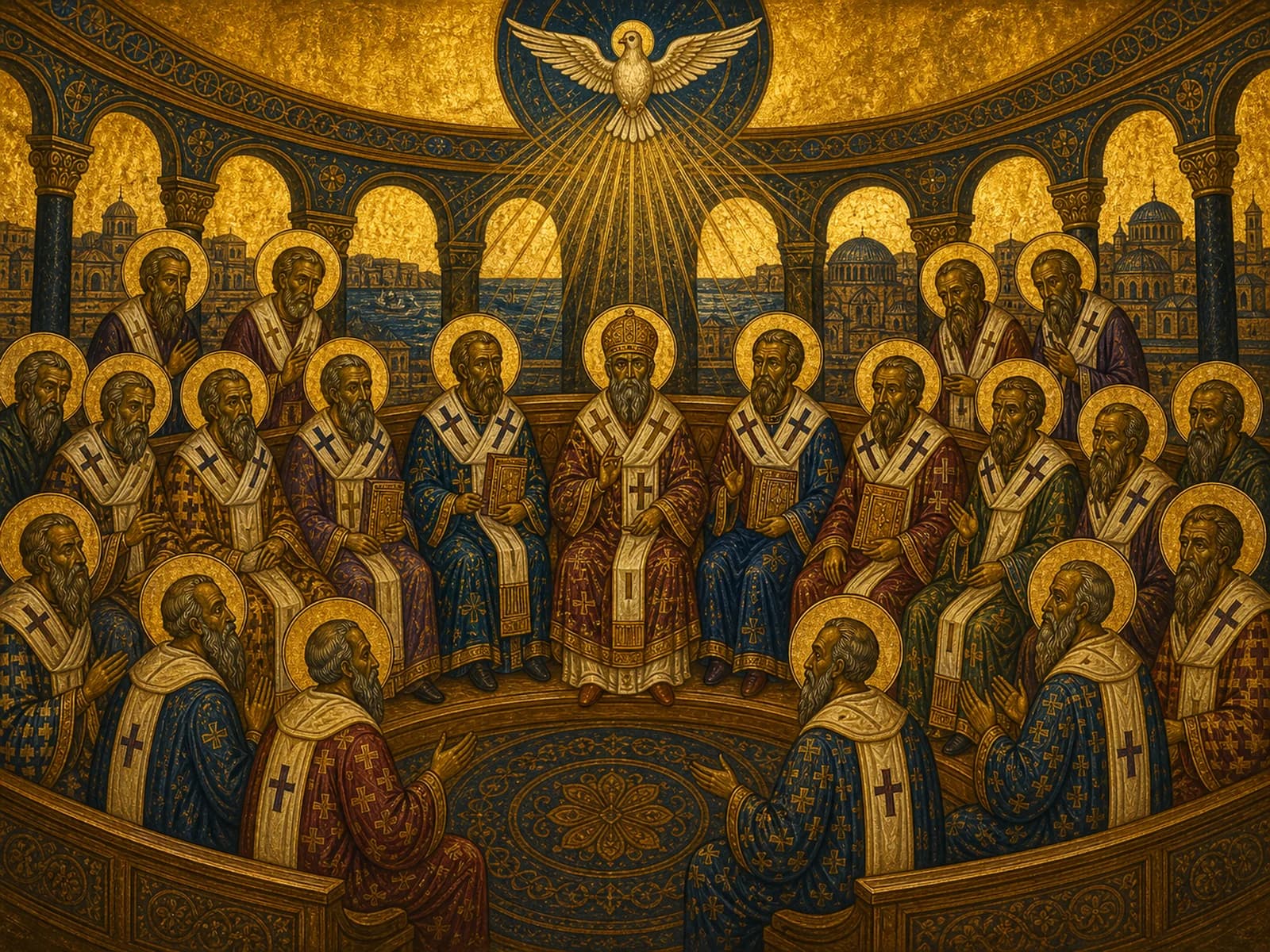
AD 381 · Constantinople
First Council of Constantinople
One hundred fifty fathers, led by Gregory the Theologian among others, completed the Creed and confessed the full divinity of the Holy Spirit — sealing the doctrine of the Trinity: one God in three consubstantial Persons.
What it faced
The Pneumatomachi (“Spirit-fighters”), who denied the full divinity of the Holy Spirit, and the remnants of Arianism; Apollinarianism, which denied Christ a human mind.
What it defined
The Holy Spirit is “the Lord, the Giver of life, who proceeds from the Father, who with the Father and the Son together is worshipped and glorified” — completing the Nicene-Constantinopolitan Creed the Church confesses to this day.
Conciliar Texts
Translated by Henry Percival from Nicene and Post-Nicene Fathers, Second Series, Vol. 14 (1900).
Creed
SourceCreed
We believe in one God, the Father Almighty, maker of heaven and earth and of all things visible and invisible. And in one Lord Jesus Christ, the only begotten Son of God, begotten of his Father before all worlds, Light of Light, very God of very God, begotten not made, being of one substance with the Father, by whom all things were made. Who for us men and for our salvation came down from heaven and was incarnate by the Holy Ghost and the Virgin Mary, and was made man, and was crucified also for us under Pontius Pilate. He suffered and was buried, and the third day he rose again according to the Scriptures, and ascended into heaven, and sits at the Right Hand of the Father. And he shall come again with glory to judge both the quick and the dead. Whose kingdom shall have no end. (I)
And [we believe] in the Holy Ghost, the Lord and Giver-of-Life, who proceeds from the Father, who with the Father and the Son together is worshipped and glorified, who spoke by the prophets. And [we believe] in one, holy, (II) Catholic and Apostolic Church. We acknowledge one Baptism for the remission of sins, [and] we look for the resurrection of the dead and the life of the world to come. Amen.
Letter
SourceLetter of the Same Holy Synod to the Most Pious Emperor Theodosius the Great, to Which are Appended the Canons Enacted by Them
To the most religious Emperor Theodosius, the Holy Synod of Bishops assembled in Constantinople out of different Provinces.
We begin our letter to your Piety with thanks to God, who has established the empire of your Piety for the common peace of the Churches and for the support of the true Faith. And, after rendering due thanks unto God, as in duty bound we lay before your Piety the things which have been done in the Holy Synod. When, then, we had assembled in Constantinople, according to the letter of your Piety, we first of all renewed our unity of heart each with the other, and then we pronounced some concise definitions, ratifying the Faith of the Nicene Fathers, and anathematizing the heresies which have sprung up, contrary thereto. Besides these things, we also framed certain Canons for the better ordering of the Churches, all which we have subjoined to this our letter. Wherefore we beseech your Piety that the decree of the Synod may be ratified, to the end that, as you have honoured the Church by your letter of citation, so you should set your seal to the conclusion of what has been decreed. May the Lord establish your empire in peace and righteousness, and prolong it from generation to generation; and may he add unto your earthly power the fruition of the heavenly kingdom also. May God by the prayers (εὐχαῖς τῶν ἁγίων) of the Saints, show favour to the world, that you may be strong and eminent in all good things as an Emperor most truly pious and beloved of God.
Document
SourceCanons of the One Hundred and Fifty Fathers who assembled at Constantinople during the Consulate of those Illustrious Men, Flavius Eucherius and Flavius Evagrius on the VII of the Ides of July.
The Bishops out of different provinces assembled by the grace of God in Constantinople, on the summons of the most religious Emperor Theodosius, have decreed as follows:
Canon · Canons of the One Hundred and Fifty Fathers who assembled at Constantinople during the Consulate of those Illustrious Men, Flavius Eucherius and Flavius Evagrius on the VII of the Ides of July.
SourceCanon 1
The Faith of the Three Hundred and Eighteen Fathers assembled at Nice in Bithynia shall not be set aside, but shall remain firm. And every heresy shall be anathematized, particularly that of the Eunomians or [Anomæans, the Arians or] Eudoxians, and that of the Semi-Arians or Pneumatomachi, and that of the Sabellians, and that of the Marcellians, and that of the Photinians, and that of the Apollinarians.
Canon · Canons of the One Hundred and Fifty Fathers who assembled at Constantinople during the Consulate of those Illustrious Men, Flavius Eucherius and Flavius Evagrius on the VII of the Ides of July.
SourceCanon 2
The bishops are not to go beyond their dioceses to churches lying outside of their bounds, nor bring confusion on the churches; but let the Bishop of Alexandria, according to the canons, alone administer the affairs of Egypt; and let the bishops of the East manage the East alone, the privileges of the Church in Antioch, which are mentioned in the canons of Nice, being preserved; and let the bishops of the Asian Diocese administer the Asian affairs only; and the Pontic bishops only Pontic matters; and the Thracian bishops only Thracian affairs. And let not bishops go beyond their dioceses for ordination or any other ecclesiastical ministrations, unless they be invited. And the aforesaid canon concerning dioceses being observed, it is evident that the synod of every province will administer the affairs of that particular province as was decreed at Nice. But the Churches of God in heathen nations must be governed according to the custom which has prevailed from the times of the Fathers.
Canon · Canons of the One Hundred and Fifty Fathers who assembled at Constantinople during the Consulate of those Illustrious Men, Flavius Eucherius and Flavius Evagrius on the VII of the Ides of July.
SourceCanon 3
Concerning Maximus the Cynic and the disorder which has happened in Constantinople on his account, it is decreed that Maximus never was and is not now a Bishop; that those who have been ordained by him are in no order whatever of the clergy; since all which has been done concerning him or by him, is declared to be invalid.
Canon · Canons of the One Hundred and Fifty Fathers who assembled at Constantinople during the Consulate of those Illustrious Men, Flavius Eucherius and Flavius Evagrius on the VII of the Ides of July.
SourceCanon 4
(Probably adopted at a Council held in Constantinople the next year, 382. Vide. Introduction on the number of the Canons.)
In regard to the tome of the Western [Bishops], we receive those in Antioch also who confess the unity of the Godhead of the Father, and of the Son, and of the Holy Ghost.
Canon · Canons of the One Hundred and Fifty Fathers who assembled at Constantinople during the Consulate of those Illustrious Men, Flavius Eucherius and Flavius Evagrius on the VII of the Ides of July.
SourceCanon 5
Those who from heresy turn to orthodoxy, and to the portion of those who are being saved, we receive according to the following method and custom: Arians, and Macedonians, and Sabbatians, and Novatians, who call themselves Cathari or Aristori, and Quarto-decimans or Tetradites, and Apollinarians, we receive, upon their giving a written renunciation [of their errors] and anathematize every heresy which is not in accordance with the Holy, Catholic, and Apostolic Church of God. Thereupon, they are first sealed or anointed with the holy oil upon the forehead, eyes, nostrils, mouth, and ears; and when we seal them, we say, "The Seal of the gift of the Holy Ghost." But Eunomians, who are baptized with only one immersion, and Montanists, who are here called Phrygians, and Sabellians, who teach the identity of Father and Son, and do sundry other mischievous things, and [the partisans of] all other heresies— for there are many such here, particularly among those who come from the country of the Galatians:— all these, when they desire to turn to orthodoxy, we receive as heathen. On the first day we make them Christians; on the second, catechumens; on the third, we exorcise them by breathing thrice in their face and ears; and thus we instruct them and oblige them to spend some time in the Church, and to hear the Scriptures; and then we baptize them.
Canon · Canons of the One Hundred and Fifty Fathers who assembled at Constantinople
SourceCanon 6
(Probably adopted at a Council held in Constantinople the next year, 382. Vide Introduction on the number of Canons.)
Forasmuch as many wishing to confuse and overturn ecclesiastical order, do contentiously and slanderously fabricate charges against the orthodox bishops who have the administration of the Churches, intending nothing else than to stain the reputation of the priests and raise up disturbances amongst the peaceful laity; therefore it seemed right to the Holy Synod of Bishops assembled together in Constantinople, not to admit accusers without examination; and neither to allow all persons whatsoever to bring accusations against the rulers of the Church, nor, on the other hand, to exclude all. If then, any one shall bring a private complaint against the Bishop, that is, one relating to his own affairs, as, for example, that he has been defrauded, or otherwise unjustly treated by him, in such accusations no examination shall be made, either of the person or of the religion of the accuser; for it is by all means necessary that the conscience of the Bishop should be free, and that he who says he has been wronged should meet with righteous judgment, of whatever religion he may be. But if the charge alleged against the Bishop be that of some ecclesiastical offence, then it is necessary to examine carefully the persons of the accusers, so that, in the first place, heretics may not be suffered to bring accusations touching ecclesiastical matters against orthodox bishops. And by heretics we mean both those who were aforetime cast out and those whom we ourselves have since anathematized, and also those professing to hold the true faith who have separated from our canonical bishops, and set up conventicles in opposition [to them]. Moreover, if there be any who have been condemned for faults and cast out of the Church, or excommunicated, whether of the clergy or the laity, neither shall it be lawful for these to bring an accusation against the bishop, until they have cleared away the charge against themselves. In like manner, persons who are under previous accusations are not to be permitted to bring charges against a bishop or any other clergyman, until they shall have proved their own innocence of the accusation brought against them. But if any, being neither heretics, nor excommunicate, nor condemned, nor under previous accusation for alleged faults, should declare that they have any ecclesiastical charge against the bishop, the Holy Synod bids them first lay their charges before all the Bishops of the Province, and before them prove the accusations, whatsoever they may be, which they have brought against the bishop. And if the comprovincials should be unable rightly to settle the charges brought against the bishop, then the parties must betake themselves to a greater synod of the bishops of that diocese called together for this purpose; and they shall not produce their allegations before they have promised in writing to undergo an equal penalty to be exacted from themselves, if, in the course of the examination, they shall be proved to have slandered the accused bishop. And if anyone, despising what has been decreed concerning these things, shall presume to annoy the ears of the Emperor, or the courts of temporal judges, or, to the dishonour of all the Bishops of his Province, shall trouble an Ecumenical Synod, such an one shall by no means be admitted as an accuser; forasmuch as he has cast contempt upon the Canons, and brought reproach upon the order of the Church.
Source Note · Canons of the One Hundred and Fifty Fathers who assembled at Constantinople
SourceWarning to the Reader Touching Canon VII
Warning to the Reader Touching Canon VII.
(Beveridge, Synodicon, Tom. II., in loc.)
This canon, I confess, is contained in all the editions of the Commentaries of Balsamon and Zonaras. It is cited also by Photius in Nomocanon, Tit. xii. ch. xiv., besides it is extant in a contracted form in the Epitome of Alexius Aristenus. But it is wanting in all the Latin versions of the Canons, in the ancient translations of Dionys. Exig., Isidore Mercator, etc.; also in the Epitome of Sym. Logothet., and the Arabic paraphrase of Josephus Ægyp., and what is particularly to be observed, in the collection and nomocanon of John of Antioch; and this not through want of attention on his part, as is clear from this namely, that in the order of the Canons as given by him he attributes six Canons only to this second General Council, saying “…of the Fathers who assembled at Constantinople, by whom six Canons were set forth,” so that it is clear the present was not reckoned among the canons of this council in those days. Nay, the whole composition of this canon clearly indicates that it is to be ascribed, neither to this present council, nor to any other (unless perhaps to that of Trullo, of which we shall speak afterwards). For nothing is appointed in it, nothing confirmed, but a certain ancient custom of receiving converted heretics, is here merely recited.
(Hefele, History of the Councils, Vol. II., p. 368.)
As we possess a letter from the Church at Constantinople in the middle of the fifth century to Bishop Martyrius of Antioch, in which the same subject is referred to in a precisely similar way, Beveridge is probably right in conjecturing that the canon was only an extract from this letter to Martyrius; therefore in no way a decree of the second General Council, nor even of the Synod of 382, but at least eighty years later than the latter. This canon, with an addition, was afterwards adopted by the Quinisext Synod as its ninety-fifth, without, however, giving its origin.
Canon · Canons of the One Hundred and Fifty Fathers who assembled at Constantinople
SourceCanon 7
Those who from heresy turn to orthodoxy, and to the portion of those who are being saved, we receive according to the following method and custom: Arians, and Macedonians, and Sabbatians, and Novatians, who call themselves Cathari or Aristori, and Quarto-decimans or Tetradites, and Apollinarians, we receive, upon their giving a written renunciation [of their errors] and anathematize every heresy which is not in accordance with the Holy, Catholic, and Apostolic Church of God. Thereupon, they are first sealed or anointed with the holy oil upon the forehead, eyes, nostrils, mouth, and ears; and when we seal them, we say, “The Seal of the gift of the Holy Ghost.” But Eunomians, who are baptized with only one immersion, and Montanists, who are here called Phrygians, and Sabellians, who teach the identity of Father and Son, and do sundry other mischievous things, and [the partisans of] all other heresies—for there are many such here, particularly among those who come from the country of the Galatians:—all these, when they desire to turn to orthodoxy, we receive as heathen. On the first day we make them Christians; on the second, catechumens; on the third, we exorcise them by breathing thrice in their face and ears; and thus we instruct them and oblige them to spend some time in the Church, and to hear the Scriptures; and then we baptize them.